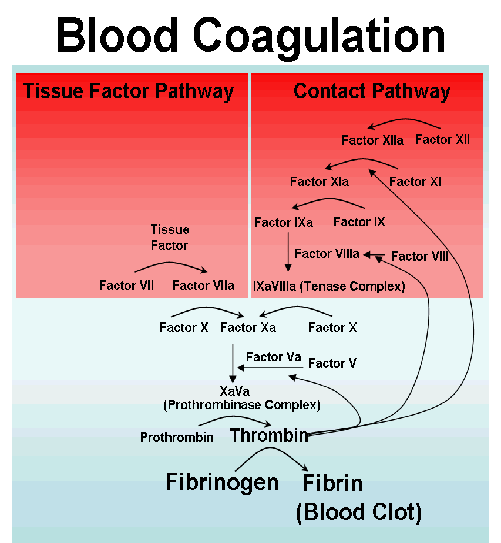
| Blood Clotting (Coagulation) The coagulation system is activated in response to vascular damage. The initial step involves the exposure of tissue factor at the injured site for factor VIIa binding . The association of these two proteins leads to the activation of factor IX and factor X to become factor IXa and Xa which bind anionic phospholipid surfaces such as activated platelets. Factor Xa then activates prothrombin to thrombin. With the generation of thrombin, soluble fibrinogen molecules are converted into an insoluble fibrin mesh at the injured site to hinder bleeding . At the same time, thrombin activates factor VIII and factor V. The resulting factor VIIIa and factor Va bind to anionic phospholipid, and form complexes with factor IXa and factor Xa, respectively. The VIIIaIXa and VaXa complexes are known as tenase and prothrombinase and are potent enzymatic activators for factor X and prothrombin, respectively. The generation of these two complexes leads to an amplification of thrombin generation for further fibrin production to arrest blood loss. Therefore, the VIIIa- and Va-containing tenase and prothrombinase complex play a central role in the amplification of thrombin generation and fibrin deposition at the site of injury. |
Cardiovascularweb
 |
| |
 |
| |
 |
| |
 |
| |
 |
| |
 |
| |
 |
| |
 |
| |
 |
| |
 |
| |
 |
| |
 |
Basic Knowledge
 | |  | |  |